Legolas. Galadriel. Arwen. Say any of these names out loud and you know, instantly, that they do not belong to a human. Nobody had to tell you. The name itself did the work.
I run an elf name generator, and this is the question readers ask me more than any other: why do elves have unique names, while human characters in the same story get called Tom, Sara or Jon?
The honest answer is that elf names were never meant to be simple labels. In most fantasy worlds, an elf’s name is a tiny piece of history. It can hold a family line, a language, a birthplace, and sometimes a whole life story, all packed into one word. Human names in our world rarely carry that much weight, so the difference jumps out the moment you read one.
Here are the seven real reasons behind it, with the actual examples writers use, and a simple method you can steal if you want to build names like these yourself.
The short answer: elves have unique names because their worlds treat a name as identity and history, not just a label. Long lives, invented languages with real grammar, family traditions, and names that are earned over a lifetime all combine to make every elf name feel deliberate, layered, and unlike any human name.
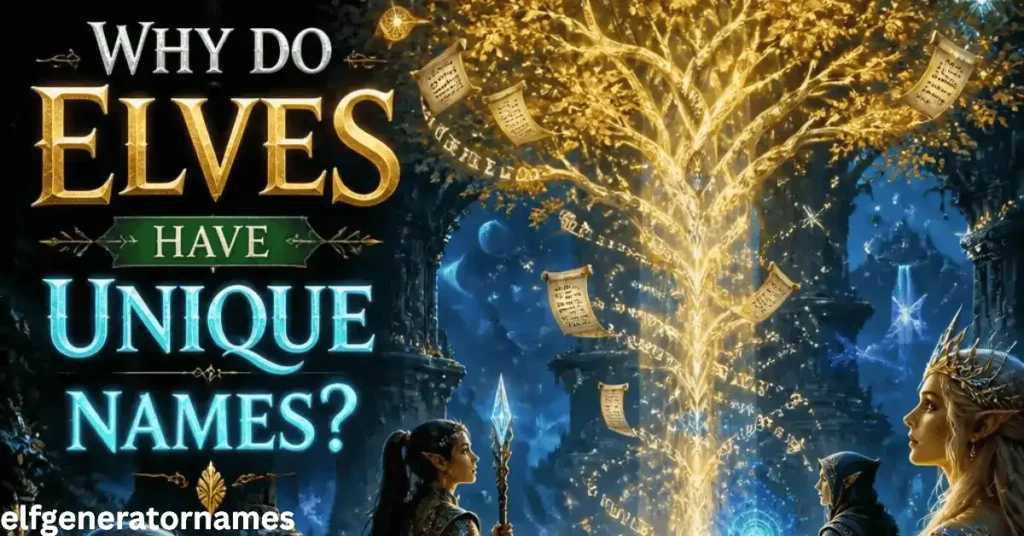
1. Elves Live for Centuries, So Their Names Collect History
Think about how human families reuse names. A boy gets named after his grandfather. That reaches back maybe a hundred years, and even then, most of us know very little about the man.
Now stretch that to a people who live for centuries. In Dungeons & Dragons lore, elf family names exist partly so bloodlines can be tracked across those long lives. An elf might meet a cousin whose branch of the family split off three hundred years ago. The family name is how they know each other. Names like Amakiir (Gemflower) or Galanodel (Moonwhisper) are not decoration. They are records.
That is the first big reason elf names feel unique. They are built to last, and to mean something, for far longer than a human lifetime.
When I name elf characters for stories on this site, I notice the same pressure myself. A name that would be fine for a human shopkeeper feels too light for a 400-year-old ranger. The age of the character pushes the name to grow.
2. Their Languages Are Real Systems, Not Random Syllables
This is where J. R. R. Tolkien changed everything.
Tolkien did not invent names and then build a world around them. He built languages first, mainly Quenya and Sindarin, with grammar, sound rules, and roots that carry meaning. The names grew out of those languages the same way real names grow out of real languages.
That is why his elf names break apart into meaningful pieces:
| Name part | Language | Meaning | Seen in |
|---|---|---|---|
| El | Sindarin | star | Elrond (“star-dome”) |
| Galad | Sindarin | radiance, light | Galadriel |
| Leg | Sindarin | green | Legolas (“green leaves”) |
| Ar | Sindarin | noble, royal | Arwen (“noble maiden”) |
| -wen | Sindarin | maiden | Arwen, Morwen |
| -iel | Sindarin | daughter, maiden | Galadriel (ending) |
Once you see this, the names stop looking mysterious and start looking engineered, in a good way. Legolas is not a random pretty sound. It literally describes green leaves, which fits a woodland prince perfectly.
Modern writers and game designers copy this approach even when they never build a full language. They fix a small set of sounds and meanings, then build every name from those parts. The names match each other, so the whole culture feels real. It is also exactly how the generator on this site builds names, and why generated names from a fixed pattern feel more “elven” than names assembled from random letters.
3. An Elf’s Name Is an Identity, Not Just a Label
Here is a detail most articles skip. In Tolkien’s writings about the Eldar, an elf did not receive just one name. Over a lifetime, an elf could carry three.
- The father-name (ataressë), given at birth by the father, often echoing the father’s own name.
- The mother-name (amilessë), given later by the mother, who was believed to see something of the child’s character and fate.
- The epessë, an after-name earned or chosen in adult life, based on deeds, appearance, skill, or a famous event.
Galadriel is actually an epessë. It was given to her later and means something like “maiden crowned with a radiant garland”. Her birth names were different. Even one of the most famous elf names in fantasy is, in the lore, a nickname that stuck.
This system explains a lot. If names are given in layers across a long life, each one chosen with care, of course they end up sounding richer than a name picked in an afternoon.
Human naming, in most fantasy worlds, is practical: a family name, a place, a saint, a trade. Elven naming is a biography written in advance, then revised as the life happens.
4. Elf Names Are Earned, and They Can Change
Following on from that, names in elf cultures are rarely frozen at birth. They grow with the person.
In the Elder Scrolls games, most Wood Elves go by a single melodic name. A second, descriptive name is unusual, and where it appears it usually points to something the elf actually did, a reputation or a feat, rather than a family surname handed down automatically. Surnames, in other words, are for the notable.
D&D has its own version. Elf children use a child name, then choose their adult name when they declare themselves grown, at around a hundred years old. Imagine getting to pick the name the world will use for the next several centuries. You would not pick something plain either.
This “earned name” habit is a big part of why elf names feel unique. Each one tends to be specific to one person’s life, not shared with half the village.
5. Nature and Lineage Are Baked Into the Name
Read a list of elf names from almost any world and count how many point at the natural world: stars, moonlight, rivers, leaves, dawn, silver, song. It is not a coincidence, and it is not just writers being poetic.
In most settings, elves are written as a people tied closely to nature and to old family lines. Their names advertise both. The family names in D&D translate into things like Moonwhisper, Silverfrond, Goldpetal, and Nightbreeze. Tolkien’s names do the same job in his own languages, as the Legolas example above shows.
For a reader, this does two things at once. The name tells you where this person comes from, and it tells you what their culture values. That is a lot of information to get from a single word, and human names in the same book rarely work that hard.
If you are building your own elf names, this is the easiest trick to copy: pick what the character’s family or homeland is known for, then build the name from that. Our elf warrior names lean on strength and battle imagery, while the elf healer names lean on herbs, light, and calm. Same method, different soil.
6. The Sound Is Designed to Feel Musical
Even readers who know nothing about Tolkien feel that elf names sound different. That feeling is mostly sound design.
Writers build elf names from soft, flowing pieces:
- Lots of vowels, especially a, e, and i
- Gentle consonants like l, r, n, th, and s
- Very few hard stops like k, g, and b packed together
- Smooth endings: -iel, -wen, -ion, -eth, -or
Compare “Galadriel” with “Gimli”. Both are famous fantasy names, but you could guess which one is the elf and which one is the dwarf without knowing anything about the books. Dwarven names are built from harder, heavier sounds on purpose. Elven names are built to be sung.
This is also why long elf names rarely feel clumsy. The syllables flow into each other, so a four-syllable name can feel lighter than a two-syllable human name full of hard sounds.
7. Writers Use Names as a Worldbuilding Shortcut
The last reason is a practical one, and writers do not talk about it much.
A novelist has very little space to convince you that an ancient culture exists. Describing its history takes chapters. A name takes one line. When you read “Thranduil”, “Celebrimbor”, or “Sylvanas”, your brain fills in palaces, forests, and old songs all by itself, before the writer describes a single one of them.
Unique elf names are, in short, cheap and powerful worldbuilding. They signal age, beauty, and difference in the fastest possible way. That is why the tradition survived long after Tolkien, through tabletop games, video games, and thousands of fantasy novels. It works, so everyone keeps using it.
How Elf Naming Works Across Different Worlds
The details change from world to world, even though the feeling stays the same. Here is the honest comparison:
| World | Who gives the name | Can it change? | Family names | Example style |
|---|---|---|---|---|
| Tolkien’s Middle-earth | Father, then mother, then life itself | Yes, an earned epessë can replace earlier names | Yes, houses and lineages matter | Galadriel, Elrond, Legolas |
| Dungeons & Dragons | Family, then chosen by the elf at adulthood | Yes, chosen again at about 100 years old | Yes, often translated (Moonwhisper) | Amakiir, Galanodel families |
| The Elder Scrolls | Given early, kept simple | Rarely; earned descriptions sometimes added | Usually none | Single melodic names like Faendal |
| Most modern fantasy | Parents, following Tolkien’s pattern | Sometimes, for plot reasons | Often | Long, soft, nature-based names |
Notice the pattern underneath all four. The more the world treats names as serious business, the more unique the names get.
How to Create a Unique Elf Name in 5 Steps
Everything above boils down to a method. If you want a name that feels like it belongs to a real elf culture, rather than one that sounds like a password, do this:
- Pick the culture first. Forest elves, high elves, and dark elves should not sound the same. Decide the flavour before the name.
- Choose a meaning. A trait, a natural image, a family trade. Meaning is the skeleton of the name.
- Build from parts. Take a beginning, a root, and an ending from the same sound family, like the table in section 2.
- Say it out loud three times. If you stumble, simplify. Real names survive being spoken.
- Check it against famous names. If yours is one letter away from Legolas, start again. Close copies feel cheap.
If you would rather skip the manual work, the elf name generator on this site follows the same steps automatically: pick the type, class, and gender, and it builds names from fixed sound patterns so they feel related, not random.
Common Mistakes That Make Elf Names Sound Fake
I see these constantly, in games, stories, and name lists sent to me by readers:
- Random apostrophes. An apostrophe should mark something in the language, not just look exotic.
- Unpronounceable strings. If a reader cannot say it, they will not remember it.
- Mixing styles. A soft Sindarin-style first name with a harsh invented surname breaks the illusion.
- Copying famous names with one letter changed. Readers spot it instantly.
- Forgetting the meaning. A name with no story behind it feels flat next to names that carry one.
FAQs About Why Elves Have Unique Names
Why do elves have unique names?
Elves have unique names because their cultures treat names as identity and history rather than simple labels. Long lives, real invented languages, family traditions, and names earned across a lifetime all combine, so each name ends up layered, meaningful, and specific to one person.
Do elf names actually mean something?
In well-built worlds, yes. Tolkien’s names break into parts with real meanings in his invented languages: Legolas means “green leaves” and Elrond means “star-dome”. Many games and novels copy this, choosing name parts that describe the character’s family, homeland, or nature.
Why are elf names so long?
Length signals age and ceremony. A longer name can hold a family line, a birthplace, and a personal meaning at once, which suits a people who live for centuries. Short names feel quick and practical; layered names feel inherited, and inherited is exactly the feeling writers want.
Can elves change their names?
In many settings, yes. Tolkien’s elves could gain an epessë, an earned after-name that sometimes replaced their earlier names. In D&D, elves choose their adult name themselves at around a hundred years old. Names that can change tend to end up more personal and more unique.
Are elf names based on real languages?
Partly. Tolkien built his elven languages properly, but he took inspiration from real ones: Finnish strongly influenced Quenya, and Welsh influenced Sindarin. The mythology behind elves themselves comes largely from Norse and Celtic traditions, which is why the names feel ancient rather than invented yesterday.
How can I make my own unique elf name?
Decide the culture, pick a meaning, build the name from consistent parts, and say it out loud to test it. If it flows and carries a story, it will feel elven. Or use a generator that follows fixed sound patterns, so the name feels related to a real culture.
Final Thoughts
Elf names are unique because, in their worlds, a name is never just a name. It is a family record, a small poem in an invented language, and sometimes a life story earned over centuries, all at once.
Once you understand that, the names stop sounding random and start sounding inevitable. And if you are naming an elf of your own, you now know the trick: give the name a culture, a meaning, and a sound, and let it grow from there.
2 thoughts on “Why Do Elves Have Unique Names? 7 Powerful Fantasy Facts ”